Why Should You Learn To Touch Type?
Typing is one of those skills that has been over looked or gone out of fashion. Most kids are familiar with computers almost as soon as they get to school, so it’s assumed they know how to use the keyboard by “hunting & pecking” at the keys. This means the slowest part of the computer is the human using the keyboard – learning to touch typing increases efficiency by 200-800% or more.
In many other countries, like Australia, Canada & America, learning to touch typing (or “keyboarding”) is recognised as a vital life skill. Be a forward-thinking school and add it to your curriculum, or at home learn to touch type to give your child a head start.

“Given the ubiquity of keyboards and the growing expectation that secondary school pupils and university students will type their essays and coursework, I think it (learning to touch type) is one the most useful skills a child can learn – at any age from seven upwards.”
John Clare, Daily Telegraph
Is there really a difference between “hunting & pecking” and touch typing?
The power of the typing by touch isn’t really about whether you can use your little finger to type Q and P. It’s about what goes on in the brain to make it all happen. Typing by touch uses a different part of the brain from writing with a pen. For more than a century, scientists have recognized the existence of “automaticity” (auto-mat-i-city): the human ability to perform actions without conscious thought. Automatic behaviours are surprisingly common, ranging from tying shoelaces to riding a bicycle and driving a car.

“With automaticity, experts outperform novices but think less about it when they do”
Professor Logan, Vanderbilt University
When you learn to touch type, your muscle memory (brain’s physical skill centre) is in control and the skill becomes unconscious. This frees your conscious brain from the process of writing, allowing your unconscious take it over. The skill increases accuracy, speed, improves spelling, reduces visual stress (focus only on the screen) and decreases load on working memory & processing as the unconscious powers the skill. Learning to Touch type will be one of the most valuable skills your child will ever learn.
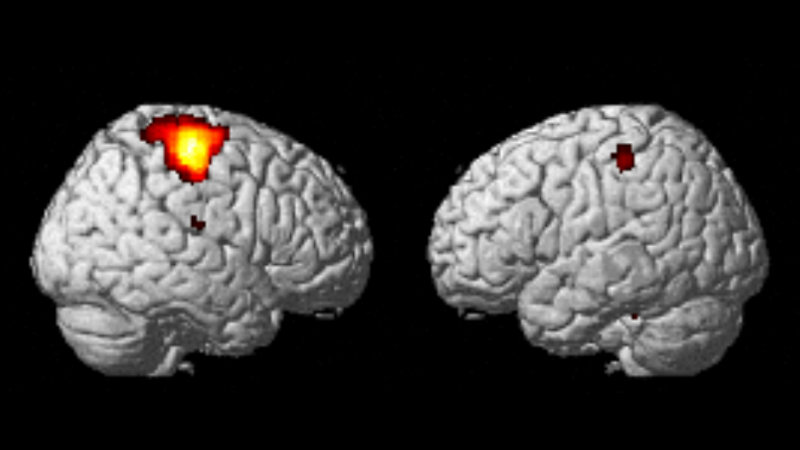
Typing movement, MRI images
Higashiyama et al, 2015, Japan, Cognitive NeuroScience PLOS
For Special Needs children, freedom from the pen can be life changing
For Special Needs or Neuro-divergent children, touch typing provides a very different option for writing and usually has a very significant effect. Completely changing how they feel about written work. Written work is usually a disliked and/or upsettingly difficult. The quality of work is not comparable to cognitive ability, and self esteem is often also damaged.
Using this different part of the brain has many advantages. Spelling becomes finger movements, colours and patterns not strings of letters. The physical skill centre is very powerful and unconscious. For children with processing issues, freeing the conscious brain from the “process” of the skill, and particularly from using a pen, will have great results.
Learning to touch type with Englishtype is great for children with Dyslexia, Dyspraxia, Dysgraphia, ASD/Austism and Visual Impairment (partially sighted). Englishtype are experts in touch typing and skill acquisition, teaching typing for 25+ years.